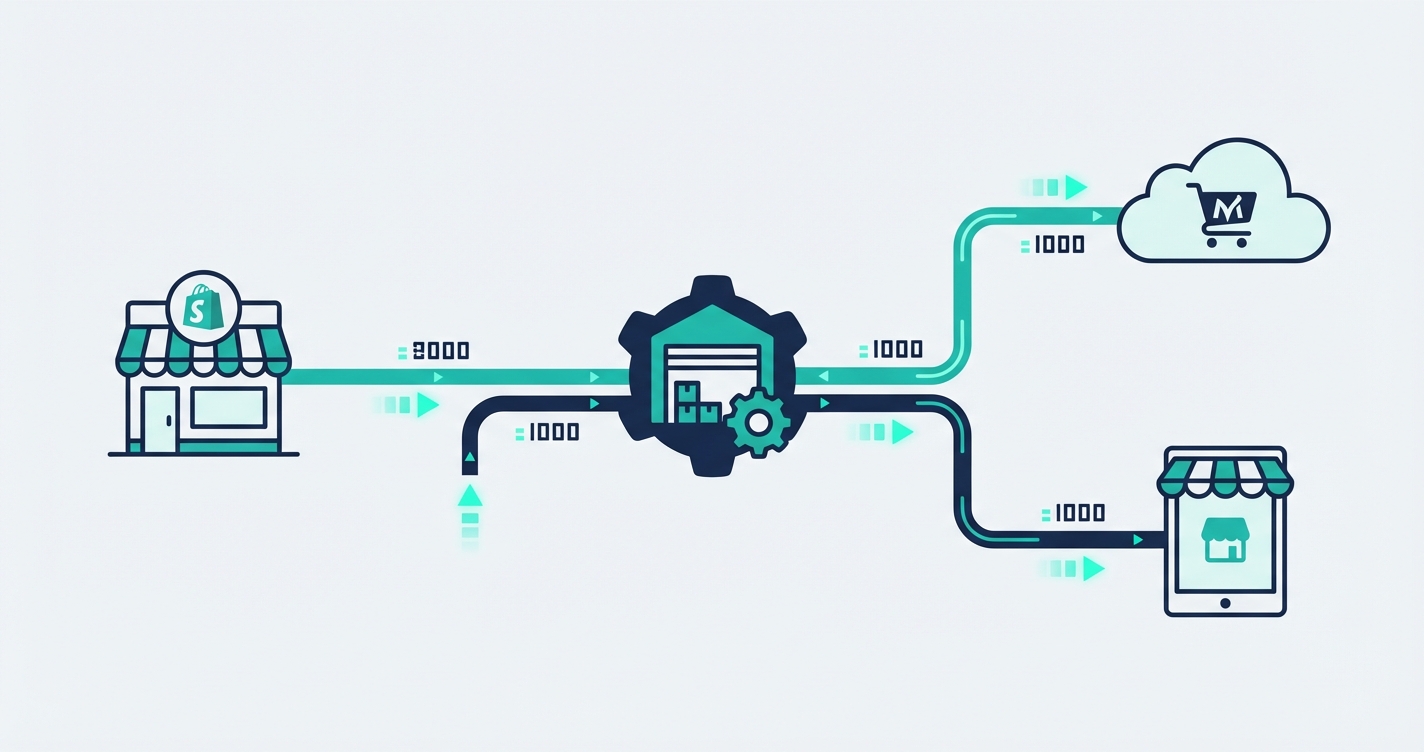
Selling on a single platform is simple. Your Shopify store shows a stock level, a customer buys a product, the stock decreases by one. But the moment you expand to a second channel — Bol.com, Amazon, a wholesale portal, or even a physical retail location — you enter a world where that simplicity vanishes. Suddenly you have the same products listed in multiple places, each with its own stock counter, and keeping those counters aligned becomes one of the most critical and most difficult challenges in e-commerce operations.
The multi-channel reality
The push toward multi-channel selling is not optional for most growing merchants. Dutch e-commerce businesses in particular often find themselves selling through Shopify as their primary webshop, Bol.com as the dominant domestic marketplace, Amazon for broader European reach, and sometimes additional channels like their own B2B portal or physical retail. Each channel brings its own customer base and revenue stream, making multi-channel presence essential for growth.
But each of these platforms maintains its own inventory system, completely independent from the others. When a customer buys the last unit of a product on Bol.com, your Shopify store does not know about it. When you receive a new shipment and update stock in Shopify, Bol.com still shows the old quantity. This fundamental disconnect is where inventory problems begin, and for many merchants, it is where operational nightmares take root.
Why inventory goes out of sync
Understanding why inventory desynchronization happens is the first step toward solving it. The problem is not carelessness — it is the inherent nature of managing parallel systems without a real-time connection between them.
Manual updates cannot keep pace
The most common approach to multi-channel inventory management is also the most fragile: manually updating stock levels on each platform whenever a sale occurs or new stock arrives. This might work when you sell a few items per day across two channels, but it breaks down rapidly as volume increases. A merchant processing fifty orders per day across three channels would need to perform roughly 150 stock adjustments daily — and each one needs to happen fast enough that another sale does not occur on a different platform before the update is made.
Timing gaps create overselling windows
Even merchants who diligently update stock across platforms face a fundamental timing problem. There is always a gap between when a sale happens on one channel and when the stock level is updated on others. During busy periods — a flash sale, a viral social media post, a seasonal rush — orders can arrive minutes or even seconds apart across different platforms. If you have three units left and two customers buy simultaneously on different channels, both platforms happily process the sale before either stock level is decremented. This timing gap is not a matter of being slow; it is a structural limitation of manual processes.
Platform-specific stock complications
Each platform may handle stock differently. Bol.com has its own fulfillment expectations and stock buffer requirements. Amazon may hold reserved stock for FBA inventory. Your Shopify store might have stock allocated across multiple warehouse locations. Managing these platform-specific nuances manually adds yet another layer of complexity and another opportunity for errors to creep in.
The consequences of poor inventory sync
Inventory sync failures are not abstract operational inconveniences. They have direct, measurable impact on your revenue, your customer relationships, and your standing on the platforms you sell on.
Overselling damages everything at once
Overselling — accepting an order for a product you do not actually have in stock — is the most immediate and painful consequence of poor inventory sync. The customer who placed the order expects their product to arrive on time. Instead, they receive an apology email and a cancellation. Their trust in your store is damaged, and they are unlikely to return. On marketplaces like Bol.com and Amazon, overselling carries additional penalties. Both platforms track your cancellation rate and use it to determine your seller performance score. Consistent overselling can result in reduced visibility, loss of buy box eligibility, or even suspension from the marketplace entirely.
Understocking leaves money on the table
The flip side of overselling is the less visible but equally costly problem of understocking. When merchants fear overselling, they often compensate by keeping artificially low stock levels on secondary channels. If you have 100 units but list only 30 on Bol.com "just to be safe," you are limiting your sales potential on that platform. Products that appear low in stock may rank lower in marketplace search results, and a listing that shows zero stock is invisible to potential buyers. This defensive understocking quietly caps your revenue across every channel except your primary one.
Customer complaints and returns increase
When inventory data is unreliable, problems ripple outward. Customers receive wrong items because the warehouse picked from incorrect stock data. Delivery times slip because an item listed as "in stock" actually needs to be reordered from a supplier. Return rates increase because customers who experience fulfillment issues are more likely to return items preemptively or lose confidence in future purchases. Each of these incidents costs money directly and damages the customer relationship indirectly.
You cannot sell what you do not have, and you cannot sell what customers cannot see. Poor inventory sync guarantees both problems simultaneously.
Need a custom integration for your Shopify store?
What real-time inventory sync looks like
Effective multi-channel inventory management replaces the manual update cycle with an automated system that keeps every channel accurate in near real-time. The core concept is straightforward: a centralized stock pool that serves as the single source of truth, with automatic adjustments pushed to every connected platform whenever something changes.
A centralized stock pool
Rather than maintaining separate stock levels on each platform, a centralized system tracks your true inventory position. When a sale occurs on any channel, the central stock is decremented and the updated quantity is immediately pushed to all other channels. When new stock arrives and you update the count in one place, every platform reflects the change within seconds. There is no timing gap large enough for overselling to occur under normal conditions, and no manual update step to forget or delay.
Safety stock and channel-specific rules
A sophisticated inventory sync system goes beyond simple mirroring. You might want to reserve a certain number of units as safety stock — a buffer that prevents the last few units from being sold to account for processing delays or returns in transit. You might want to allocate different percentages of available stock to different channels based on their sales velocity. You might need to handle bundles, where a sale of a gift set reduces the stock of three individual products. Real-time inventory sync handles all of these scenarios through configurable rules that are applied automatically with every stock adjustment.
Multi-location support
For merchants with multiple warehouses, fulfillment centers, or retail locations, inventory sync needs to account for where stock physically sits. A customer in the Netherlands should see stock available from your Dutch warehouse, while a customer in Germany might be served from a different location. Multi-location inventory sync aggregates stock across all locations for each channel while respecting fulfillment logic and shipping constraints.
Technical approaches: webhooks versus polling
Behind the scenes, inventory sync systems use two primary mechanisms to keep data current. Webhook-based synchronization listens for real-time events — a sale on Shopify triggers an immediate stock update across all other channels. This approach offers the fastest possible sync time, typically under a minute from sale to update. Polling-based synchronization periodically checks each platform for changes, usually every few minutes. While slightly slower, polling serves as a reliable fallback that catches any events webhooks might miss due to network issues or platform outages.
The most robust integrations combine both approaches. Webhooks provide near-instant synchronization during normal operations, while scheduled polling acts as a safety net that periodically reconciles stock levels across all platforms to catch and correct any discrepancies. This dual approach ensures that even if a webhook is delayed or lost, the inventory data self-corrects within minutes rather than drifting further out of sync.
BolSync: multi-channel inventory in practice
For Dutch merchants selling on both Shopify and Bol.com, we built BolSync to solve exactly this problem. BolSync maintains a real-time connection between Shopify and Bol.com inventory, ensuring that a sale on either platform immediately adjusts stock on the other. Product mapping is handled intelligently using EAN codes, so even products with different titles or descriptions across platforms are correctly linked.
Merchants who previously spent hours each day manually updating Bol.com stock levels to match their Shopify inventory found that BolSync eliminated that work entirely. More importantly, the overselling incidents that plagued their Bol.com seller score dropped to near zero, improving their marketplace performance metrics and restoring buy box eligibility that they had lost due to cancellation rates. The integration also handles order synchronization and shipment tracking, creating a unified operational flow where Shopify serves as the central hub and Bol.com stays perfectly in step.
Getting multi-channel inventory right
The merchants who succeed at multi-channel selling are not the ones who work harder at manual stock management. They are the ones who recognize that human-speed updates cannot keep pace with multi-platform sales velocity and invest in automated synchronization accordingly. Every day you manage inventory manually across multiple channels is a day you risk overselling, a day you leave revenue on the table through defensive understocking, and a day you spend hours on work that software can do in seconds.
If your multi-channel ambitions are being held back by inventory management challenges, the solution is not to sell on fewer platforms. It is to connect the platforms you sell on with real-time synchronization that makes multi-channel selling as simple as selling on one.
Struggling with inventory across Shopify and other channels? Get in touch and we will design a synchronization solution that keeps every platform accurate, every minute of every day. We respond with a proposal within 24 hours.