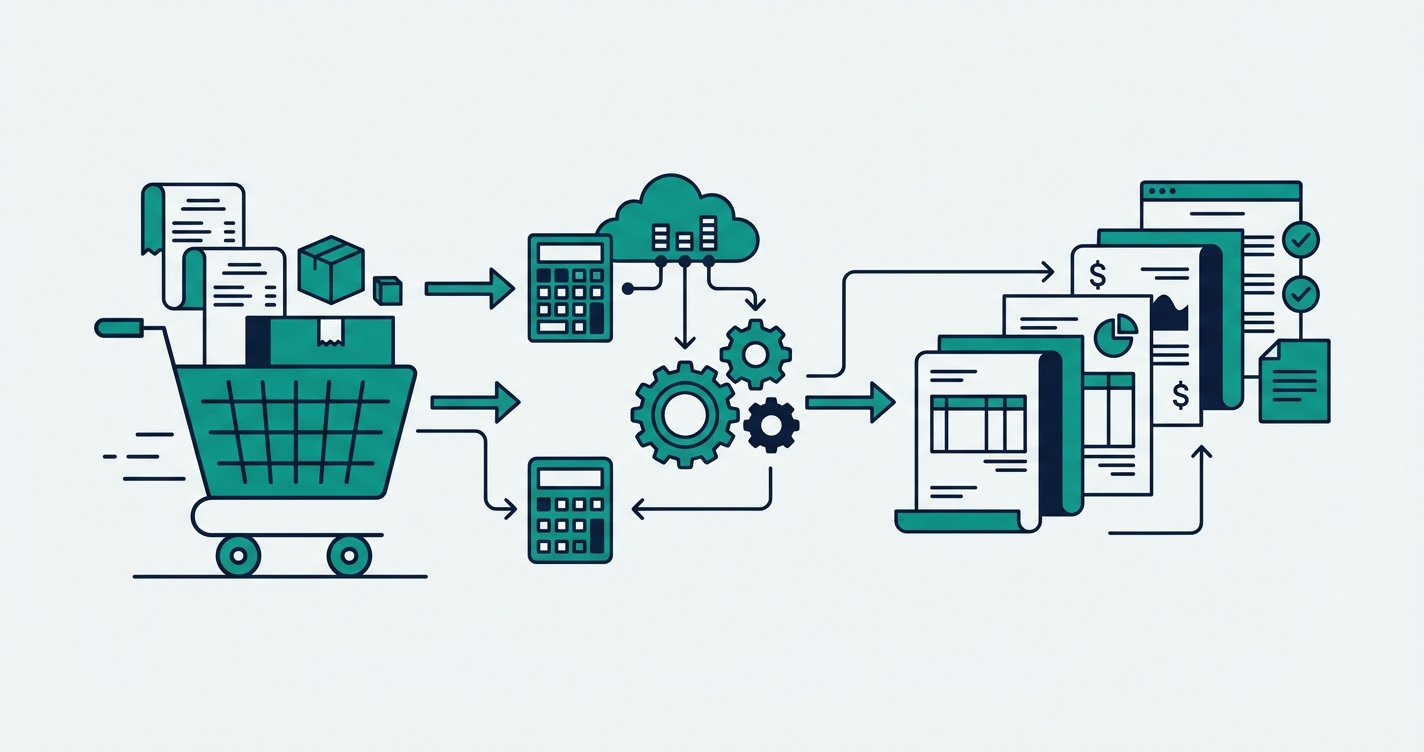
Every Shopify merchant knows the routine. An order comes in, and you open another tab to create an invoice in your accounting software. You copy the customer name, the address, the line items, the amounts. Then you update your inventory spreadsheet. Then you log the shipment details in your fulfillment system. It takes five minutes per order, and it feels manageable — until you do the math on what those five minutes actually cost your business.
The time you are really spending
Manual data entry has a way of hiding in plain sight. Because it happens in small increments scattered throughout the day, it never feels like a major time investment. But the numbers tell a different story. If you spend just two hours per day on manual data entry tasks — copying orders into accounting software, updating stock levels across platforms, creating shipping labels from order details — that adds up to roughly 44 hours every month. That is more than a full working week, every single month, spent on work that adds zero strategic value to your business.
For many store owners, the real number is even higher. Once you account for the context switching — closing Shopify, opening Moneybird, finding the right contact, cross-referencing an order number, going back to Shopify to check a detail you forgot — each task takes longer than it should. Research consistently shows that switching between applications costs an additional 20 to 40 percent of your productive time, time that never shows up in any simple estimate.
What your time is actually worth
Consider what those 44 hours per month mean in financial terms. If you value your time at 50 euros per hour — a conservative number for a business owner whose time could be spent on marketing, product development, or customer relationships — that is 2,200 euros per month spent on copy-pasting. Over a year, it exceeds 26,000 euros. And that calculation only accounts for the direct time spent. It does not include the opportunity cost of what you could have accomplished instead, which for most growing stores is significantly higher.
Errors that cost real money
Time is only part of the equation. The more insidious cost of manual data entry lies in the mistakes it inevitably produces. Humans are not designed to accurately transfer strings of numbers and addresses between systems for hours on end. Even the most careful operator will make errors, and in e-commerce, those errors have direct financial consequences.
Wrong quantities and pricing mistakes
A transposed digit in an order quantity means shipping ten units instead of one, or charging a customer 19.50 instead of 195.00. These mistakes are surprisingly common when data is entered manually, and they are expensive to unwind. You absorb the cost of the extra shipment, or you have an awkward conversation with a customer about an undercharge, or you issue a refund and lose the sale entirely. Each incident might seem small in isolation, but across hundreds of orders per month, pricing and quantity errors can silently erode your margins by several percentage points.
Missed orders and duplicate invoices
When order processing depends on a person remembering to transfer every order from one system to another, orders will inevitably slip through the cracks. A missed order means a delayed shipment, a frustrated customer, and potentially a lost relationship. On the other side of the coin, duplicate invoices — created because someone was not sure whether an order had already been entered — lead to accounting headaches, confused customers, and hours spent reconciling records at the end of the month.
Shipping mistakes that destroy trust
A wrong address copied from Shopify to your shipping provider means a package that arrives at the wrong doorstep or does not arrive at all. The direct cost includes the reshipping expense and potentially a lost product. But the indirect cost is far greater: a customer who receives the wrong item or waits weeks for a package is unlikely to return. Studies show that 73 percent of consumers say delivery experience directly impacts their decision to shop with a brand again. One shipping mistake, caused by a simple copy-paste error, can cost you the entire lifetime value of that customer.
The compounding problem of growth
Here is where manual data entry becomes truly dangerous: it scales linearly with your order volume, but your ability to handle it does not. When you process twenty orders per day, manual entry is tedious but survivable. At fifty orders per day, it becomes your entire job. At a hundred orders per day, it is physically impossible for one person to keep up without sacrificing accuracy.
This creates a painful growth ceiling. Many Shopify merchants find themselves in a position where increasing their marketing spend would drive more sales, but they cannot process the orders they already have efficiently enough to handle additional volume. The business is literally constrained by how fast someone can copy and paste. The only apparent solution is to hire additional staff to do more data entry, which adds payroll costs, training time, and management overhead — all to perform a task that should not require human involvement in the first place.
The most expensive way to enter data is by hand. Not because of the labor cost, but because of every opportunity you miss while doing it.
Need a custom integration for your Shopify store?
How automation pays for itself immediately
The case for automation is not about technology for its own sake. It is a straightforward financial calculation. When you automate the flow of data between Shopify and your other business systems, three things happen simultaneously: you reclaim all the hours previously spent on manual entry, you eliminate the errors that were costing you money, and you remove the growth ceiling that was limiting your revenue.
A well-designed integration handles order data transfer in seconds, with perfect accuracy, regardless of whether you process twenty orders or two thousand. There is no context switching, no transposition errors, no missed orders, and no duplicates. The data simply flows from one system to the next, exactly as it should, every single time.
A real example: invoice automation
One of our merchants was spending more than ten hours per week creating invoices in their accounting software from Shopify orders. Every order required opening the accounting tool, finding or creating the contact, entering line items, applying the correct VAT rate, and saving the invoice. Returns meant creating credit invoices manually and matching them to the originals. At the end of each month, they spent an additional full day reconciling discrepancies between Shopify and their bookkeeping.
After implementing automated invoice synchronization through MoneybirdSync, invoices are created automatically the moment an order is placed. Contacts are matched intelligently, VAT is applied based on configurable rules, and credit invoices for returns are generated without any human involvement. That merchant recovered more than ten hours per week — over 40 hours per month — and completely eliminated the end-of-month reconciliation headaches. The time saved in the first month alone was worth many times the cost of the integration.
Recognizing when it is time to automate
If you find yourself spending more than thirty minutes per day on data entry between platforms, the math already favors automation. If you have ever shipped to a wrong address because of a copy-paste error, or discovered a missing invoice during tax season, or turned down a marketing opportunity because you were not sure you could handle the extra orders, automation is not just favorable — it is overdue.
The real cost of manual data entry is not the time you see on the clock. It is the compounding effect of errors, the opportunities you miss, and the growth you leave on the table. Every day you continue to copy-paste is a day your business pays a tax that your competitors who have automated do not.
Ready to stop paying the manual data entry tax? Get in touch and we will show you exactly how much time and money automation can save your specific store. We respond with a proposal within 24 hours.